
Before spending money on a home improvement, most people want to know one thing: will it add value? With air conditioning, the honest answer is that nobody can promise you a fixed figure on your house price. What a well-designed system can do is make a home noticeably nicer to live in all year, and that tends to matter to buyers and tenants too.
The honest bit first: there is no magic percentage
You will find articles claiming air conditioning adds a set percentage to a property’s value. We have not seen reliable UK data that backs a single figure, so we will not quote one. House prices depend on location, condition, size, schools, transport and dozens of other things. Any effect from air conditioning varies by property type, location and, above all, the quality of the installation.
A neat, quiet, well-positioned system that heats and cools is an asset. A noisy box in the wrong place, with pipework stapled across the front of the house, is not. So the real question is less “does air conditioning add value?” and more “what makes it add value rather than take it away?”
Why buyers are paying more attention to summer comfort
UK summers have changed. The UK recorded 40°C for the first time in July 2022, and hot spells now come up in conversations with homeowners every year. Lots of British houses were designed to hold onto heat in winter, which is exactly why bedrooms in lofts, south-facing rooms and rooms with big glazing can become hard to live in during a warm spell.
Buyers walking round in July notice that. A home that stays comfortable on a hot afternoon, and lets you sleep at night, makes a better impression than one where every window is open and a fan is running in each room.

Where the practical value comes from
Heating as well as cooling
Modern air conditioning is a reverse-cycle heat pump. In summer it moves heat out of the room. In cooler weather it can move heat in. That makes it useful for far more than a few hot weeks: think of a garden office, a loft conversion or a cold extension that never quite warms up from the radiators.
Quiet, efficient equipment
Current systems are much quieter and more efficient than the units many people picture. For example, Toshiba’s Seiya range is A++ rated and has a quiet mode that Toshiba quotes as low as 19dB. Check the energy label and the sound data for the specific model, because they vary.
A tidy, discreet finish
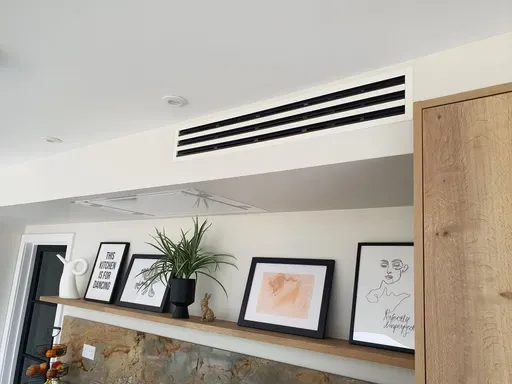
Appearance matters for resale. That means thinking about where the indoor unit sits, where the pipework runs, and where the outdoor unit goes. Ground-level outdoor units on anti-vibration feet, with neat trunking, are often a better look than a box high on the front wall. Our guide to hidden vs wall-mounted air conditioning explains the options.
The renovation timing advantage
If you are planning an extension, loft conversion or major refurbishment, that is the best time to think about air conditioning. When ceilings and floors are already open:
- pipework and cables can be hidden in the structure rather than run in trunking
- a ducted system can go in, with only slim grilles on show
- we can work alongside your builder, so there is one round of disruption rather than two
Retrofitting later is still possible, but it usually means more visible pipework or more making good. Planning ahead costs nothing and gives you more options.
For landlords
If you let property, comfort complaints in hot weather are common, especially in top-floor flats and loft rooms. A properly installed system can help, but there are a few things to think about first:
- Permission: flats, listed buildings and homes in conservation areas may need consent from the freeholder or the council. We check this with you at the survey.
- Servicing: air conditioning needs regular cleaning and servicing to keep it hygienic and efficient. See our air conditioning servicing page.
- Costs and tax: servicing and repairs are usually treated as running costs for a rental business, but your accountant is the right person to confirm how they apply to you.
Warranty is part of the value too
A future buyer will want to know the system has been looked after. As a Toshiba T7 Partner, we can offer Toshiba systems with a manufacturer warranty of up to 7 years when the system is registered and serviced annually. Keep the paperwork and service records together, and they become part of the story when you sell.
Our view
If you are planning to stay, put comfort first: air conditioning is about better sleep, usable rooms in summer and efficient heat in spring and autumn. If you are planning to sell in the next year or two, focus on a tidy, discreet installation and keep the records. Either way, the quality of the design and installation decides whether the system adds appeal.
See real examples in our air conditioning case studies, read about our air conditioning installation service, check our prices, or get a free quote.
Questions we get asked
Will air conditioning increase my house price?
We cannot promise a figure, and we are wary of anyone who does. A neat, quiet system that heats and cools can make a home more appealing, but the effect varies by property and location.
Could a badly installed system put buyers off?
Yes. Noisy units, poorly placed outdoor units and messy pipework can count against a property. That is why we plan the routes and positions with you before we start.
Do I need planning permission?
Most homes do not, but some properties such as listed buildings, flats and homes in conservation areas may. We will check this with you at your survey.
Is now a good time to install?
If you are renovating, yes, because hidden routes are easier while the work is open. HMRC’s guidance also currently zero-rates qualifying installations until 31 March 2027. See our 0% VAT guide.
Ready when you are
Tell us what you need and we will come back to you with a clear, fixed price. No pressure, no hard sell.
Ready when you are
Tell us what you need and we will come back to you with a clear, fixed price. No pressure, no hard sell.